Electrical Discharge

Electrical Discharge

Advanced EDM solutions for manufacturing intricate components, precision tooling, and complex geometries with exceptional accuracy. We deliver high-precision machined components using Wire EDM and Sinker EDM processes, enabling the production of detailed profiles, sharp corners, deep cavities, and hard-to-machine features without inducing mechanical stresses. Our capabilities support tooling, moulds, dies, aerospace components, and precision engineering applications requiring micron-level accuracy.

Precision EDM Machining for Demanding Applications

Precision EDM solutions for intricate tooling and complex components requiring exceptional accuracy and fine-detail machining. EDM enables the machining of hardened materials and intricate geometries that are difficult or impossible to achieve through conventional cutting methods..

tab-1-1

Up to 1000 × 800 × 400 mm

tab-1-2

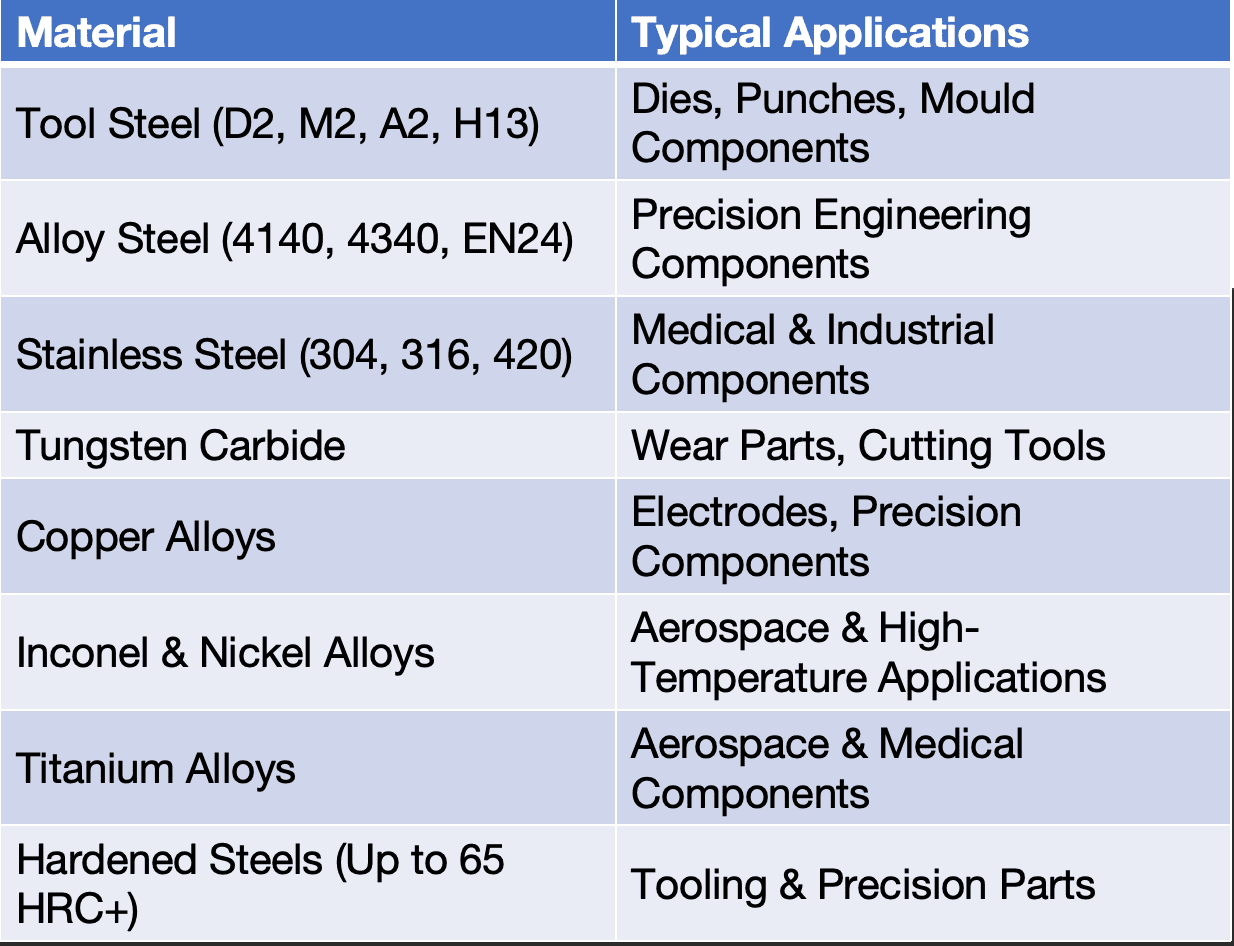
Mild Steel to Hardened Steel

tab-1-3

Prototype to Production

Materials we EDM Machining

Dimensional Capability

Our EDM Machining infrastructure supports a broad dimensional range, enabling precision machining of both small components and large industrial parts.

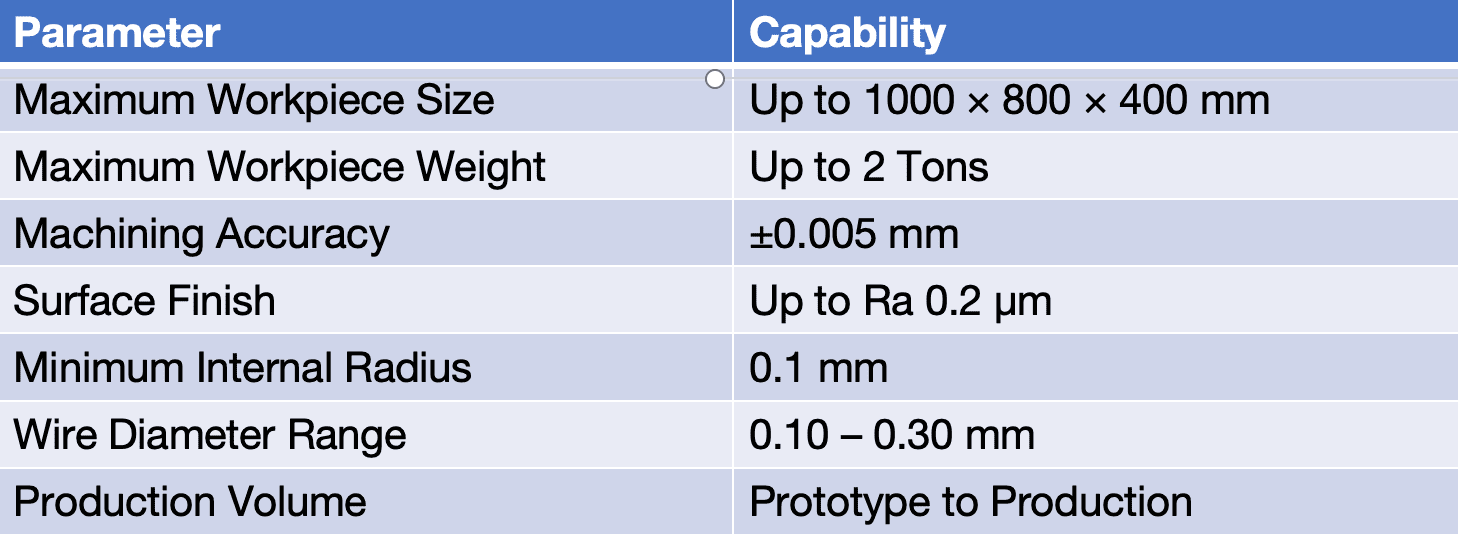
Machine Specifications

Advanced EDM Machining systems equipped for precision, accuracy with good finishing

Maximum Workpiece Size:Up to 1000 × 800 × 400 mm

Minimum Internal Radius:
0.1 mm
Automatic Wire
Threading

Wire Diameter Range: 0.10 – 0.30 mm

Accuracy:
±0.005 mm

Integrated Quality Control

Quality control is embedded throughout our EDM machining operations to ensure exceptional accuracy, dimensional consistency, and process reliability for precision components and tooling. From material verification to final inspection, every stage is governed by structured quality control procedures. In-process inspections are performed to verify critical dimensions, profile accuracy, cavity geometry, wire path integrity, and surface finish using calibrated measuring instruments and advanced inspection equipment. Particular attention is given to features such as sharp internal corners, fine details, deep cavities, and tight tolerances that are characteristic of EDM-manufactured components. Electrode validation, machining parameter control, and dimensional verification are carried out throughout the process to ensure repeatable results and consistent quality across production batches. For Wire EDM applications, cutting accuracy and profile conformity are continuously monitored to maintain precision requirements. Final inspection and documentation ensure that all components conform to customer drawings, GD&T specifications, and applicable industry standards before delivery. By integrating quality assurance into every phase of EDM manufacturing, we deliver high-precision components, tooling, mould inserts, and die components with outstanding accuracy, surface finish, repeatability, and reliability.

At Graphler Precision Manufacturing, our production capabilities are supported by structured engineering processes, inspection systems, and technical validation practices that ensure precision, reliability, and repeatability at every stage.

Process Engineering Support

We conduct feasibility reviews, DFM analysis, and machining strategy planning to optimize, manufacturability, reduce risk, and improve production efficiency before execution begins.

Dimensional Inspection & Verification

Our quality systems incorporate calibrated measurement tools, in-process inspection, and final validation to ensure components meet specified tolerances and functional requirements.

Continuous Process Optimization

Through structured feedback loops and performance monitoring, we refine cycle times, tool strategies, and machining parameters to deliver consistent quality and scalable production outcomes.

Forging the sustainable future of steel

FAQ's

What is EDM and when is it necessary?

Electrical Discharge Machining (EDM) is utilized to manufacture intricate geometries, sharp internal corners, and deep cavities that are difficult to achieve through conventional machining. It is ideal for hard-to-machine materials like hardened steels, carbides, and exotic alloys.